> For the complete documentation index, see [llms.txt](https://docs.duplicati.com/llms.txt). Markdown versions of documentation pages are available by appending `.md` to page URLs; this page is available as [Markdown](https://docs.duplicati.com/backup-destinations/file-synchronization-providers/onedrive-for-business-destination.md).
# OneDrive For Business Destination
This page describes the OneDrive For Business storage destination
{% hint style="danger" %}
This backend is **deprecated** as Microsoft has shut down the API it was calling. Use the [OneDrive](/backup-destinations/file-synchronization-providers/onedrive-destination.md) backend which uses the Microsoft Graph API and is also compatible with OneDrive for Business. Migrate existing backups to the new backend.
{% endhint %}
Duplicati supports using [Microsoft OneDrive for Business](https://www.microsoft.com/en-us/microsoft-365/onedrive/onedrive-for-business) as a storage destination. Note that Duplicati stores compressed and encrypted volumes on OneDrive and does not store files so they are individually accessible from OneDrive.
## User interface
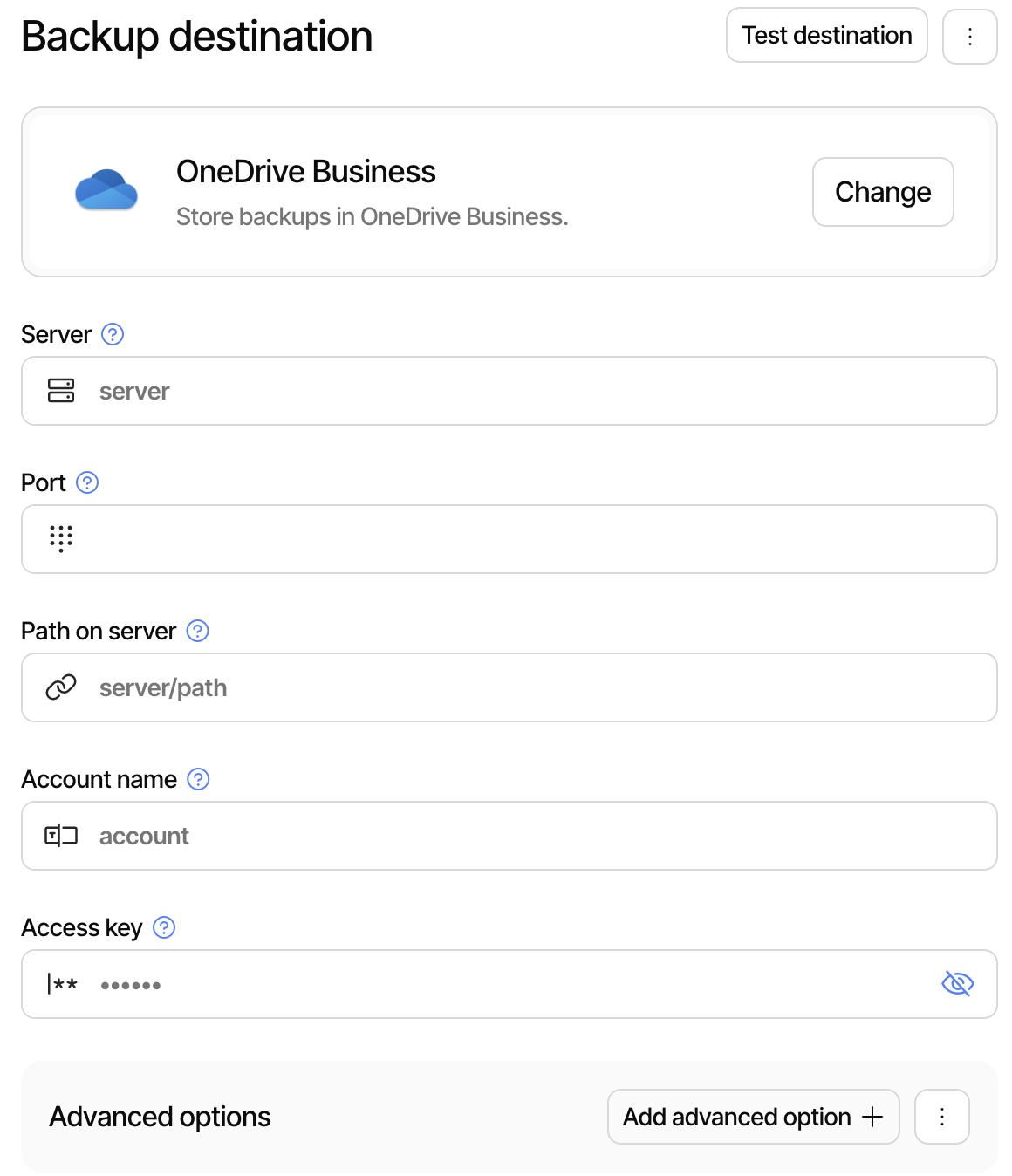
To use the OneDrive for Business dialog you must enter the server, path on server, account name and access key. You can use the "Add advanced option" button to configure some of the options described below.
## URL format for Commandline
To use OneDrive For Business, use the following URL format:
```
od4b:///
?auth-username=
&auth-password=
```
## Integrated Authentication (Windows only)
If you are on Windows, it may be possible to use the current user's credentials to authenticate. Support for this is depending on many details and is not available in all cases. To use integrated authentication, use the following URL format:
```
od4b:///?integrated-authentication=true
```
## Advanced options
Instead of deleting files directly, they can be moved to the recycle bin by setting the option `--delete-to-recycler.` This gives some additional safety if a version removal was unintended, but is not generally recommended, as it is a manual process to recover from a partial delete.
The options `--web-timeout` and `--chunk-size` can be used to fine-tune performance that matches your setup, but generally it is recommended to keep them at their default values.
If you are running Duplicati in a data center with a very stable connection, you can use the option `--binary-direct-mode` to enable direct transfers for optimal performance.
---
# Agent Instructions
This documentation is published with GitBook. GitBook is the documentation platform designed so that both humans and AI agents can read, navigate, and reason over technical content effectively. Learn more at gitbook.com.
## Querying This Documentation
If you need additional information that is not directly available in this page, you can query the documentation by asking a question.
Perform an HTTP GET request on the following URL with the `ask` and `goal` query parameters:
```
GET https://docs.duplicati.com/backup-destinations/file-synchronization-providers/onedrive-for-business-destination.md?ask=&goal=
```
`ask` is the immediate question: it should be specific, self-contained, and written in natural language.
`goal` is what the user is ultimately trying to achieve, the reason they need the answer. Sharing it helps GitBook give you a better, more relevant answer. A goal is most helpful when it describes the outcome the user wants rather than restating the question. For example, with `ask=how do I create an API token`, a goal like `automate deployments from our CI pipeline` lets GitBook tailor the answer to that use case.
The response will contain a direct answer to the question and relevant excerpts and sources from the documentation.
Use this mechanism when the answer is not explicitly present in the current page, you need clarification or additional context, or you want to retrieve related documentation sections.