> For the complete documentation index, see [llms.txt](https://docs.duplicati.com/llms.txt). Markdown versions of documentation pages are available by appending `.md` to page URLs; this page is available as [Markdown](https://docs.duplicati.com/automation-and-integration/full-disk-backup-and-restore.md).
# Full-disk backup and restore
This page describes how to back up and restore full disks and individual partitions with Duplicati
Duplicati supports backing up an entire disk, or individual partitions on a disk, as the backup source. Unlike a regular file-based backup, a full-disk backup reads the disk directly and also captures the disk geometry, such as the partition table and boot information. This makes it possible to restore the backup onto a blank replacement disk and end up with a bootable system, without reinstalling the operating system first.
**Key characteristics**
* **Disk-level source**: Back up a complete disk, including the partition layout, or pick just the partitions you need.
* **Flexible restore**: Restore disk-to-disk, partition-to-partition, or a partition from a full-disk backup onto another partition.
{% hint style="warning" %}
Reading raw disks requires elevated privileges. Run Duplicati as a service or with administrator/root permissions, otherwise the backup or restore will fail.
{% endhint %}
## Setting up a full-disk backup
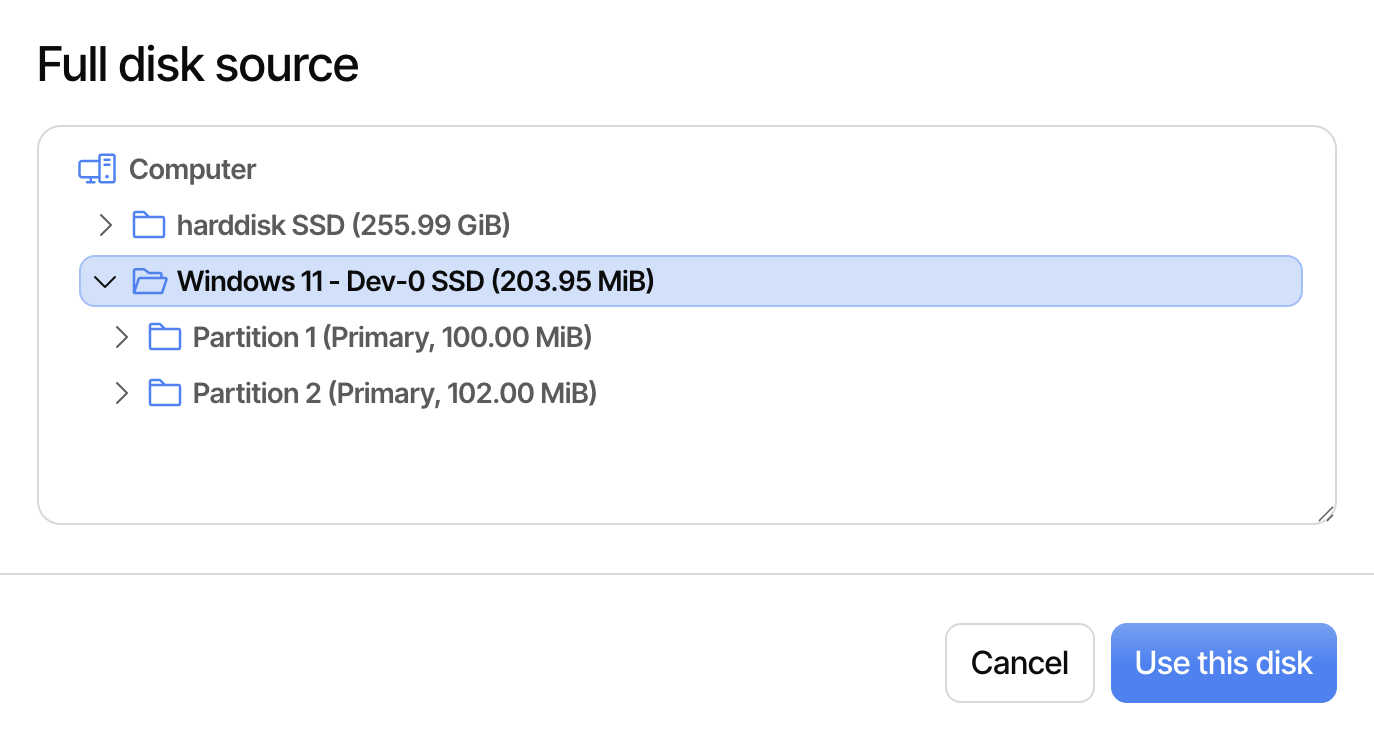
To create a full-disk backup, [set up a backup following the regular steps](/getting-started/set-up-a-backup-in-the-ui.md). On the "Source Data" page, click the "Add local disk" button to browse local disks:
Choosing a disk in the full-disk source picker
Selecting the disk itself backs up the entire disk, including the partition table and all partitions. Selecting a single partition backs up only that partition, which is functionally the same as selecting the full disk and filtering out the unwanted partitions, but more intuitive when only one partition is needed.
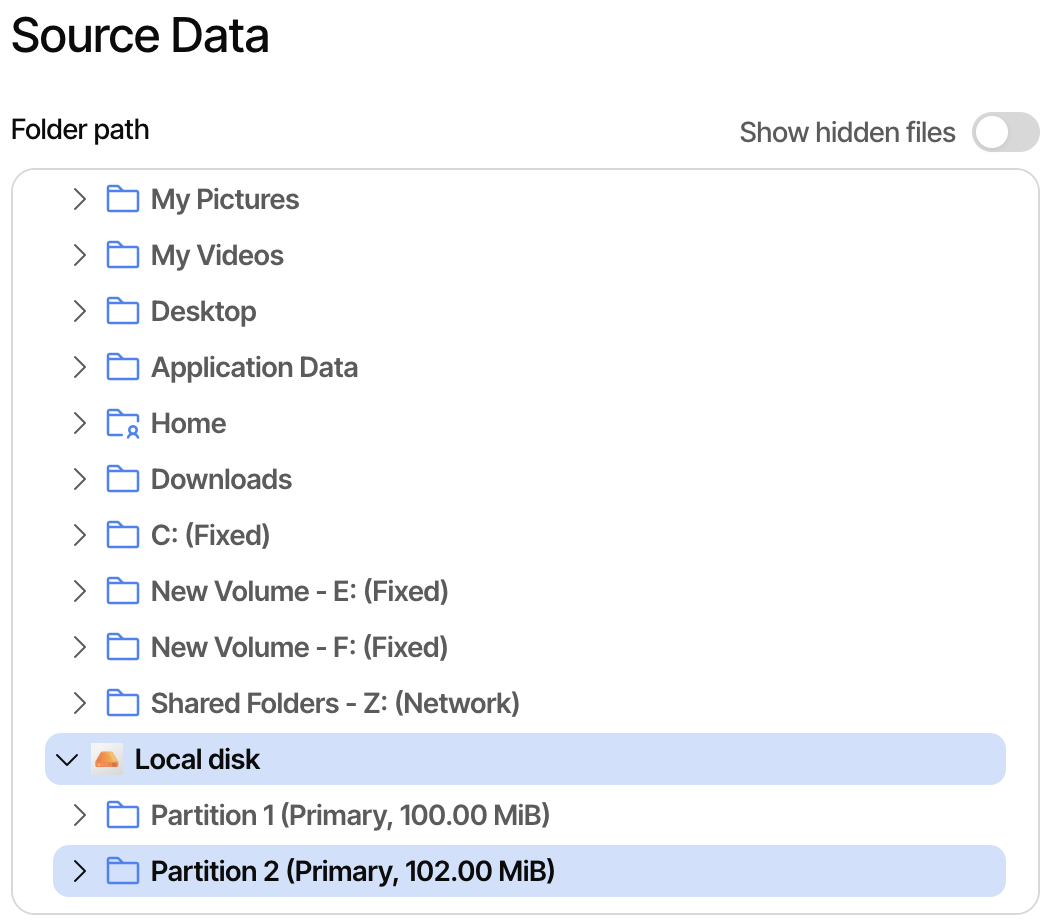
Once a disk has been adedd, it will show up in the source tree, where you can expand it to see available partitions:
Selecting a disk or partition as the backup source
You can click the individual partitions to toggle their inclusion, if you only want specific partitions.
After choosing the source, continue with the schedule and retention settings as for a regular backup.
## Restoring a full-disk backup
A full-disk backup is restored through the regular [restore flow](/getting-started/restoring-files.md), either from the existing backup configuration or directly from the backup files.
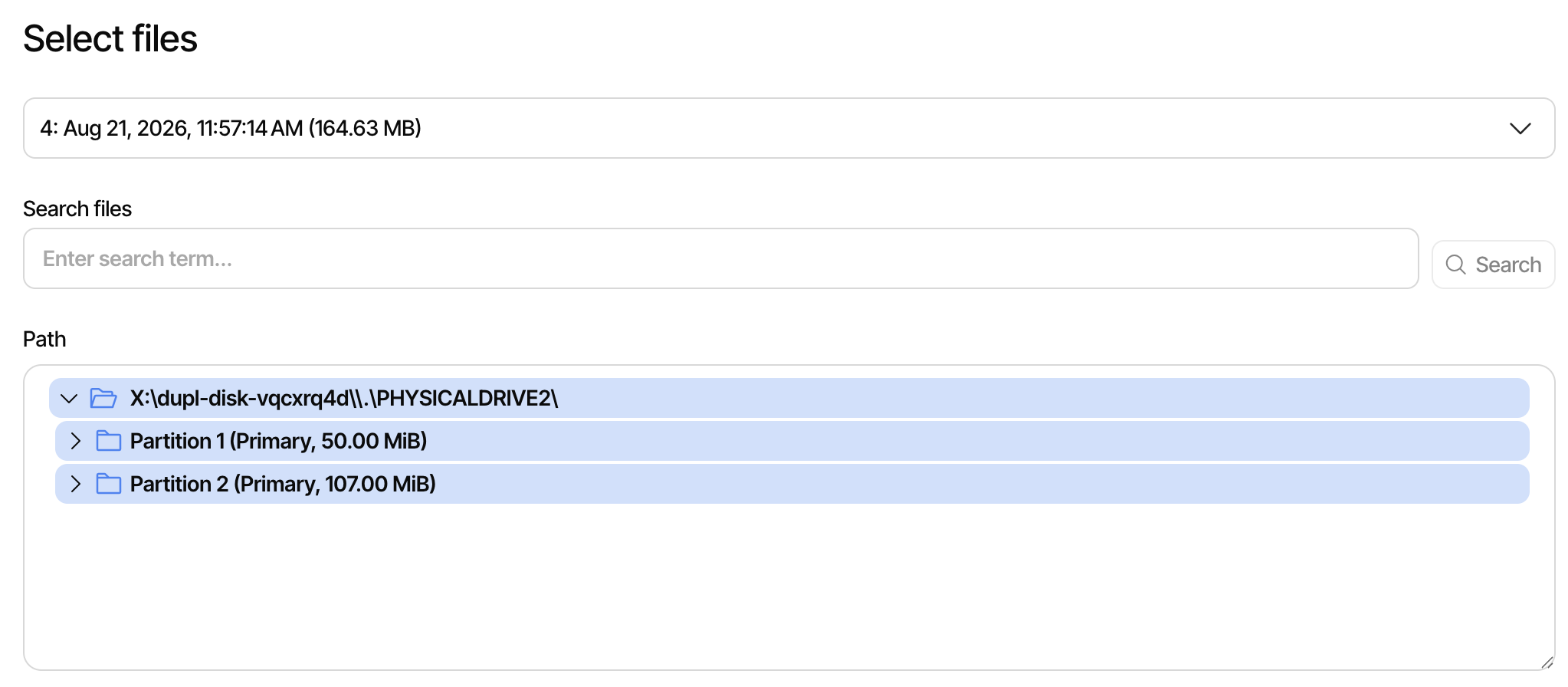
When choosing what to restore, the backup version lists the disk with its partitions. Select the disk to restore everything, or expand it and select only the partitions you need:
Choosing a disk or partition to restore
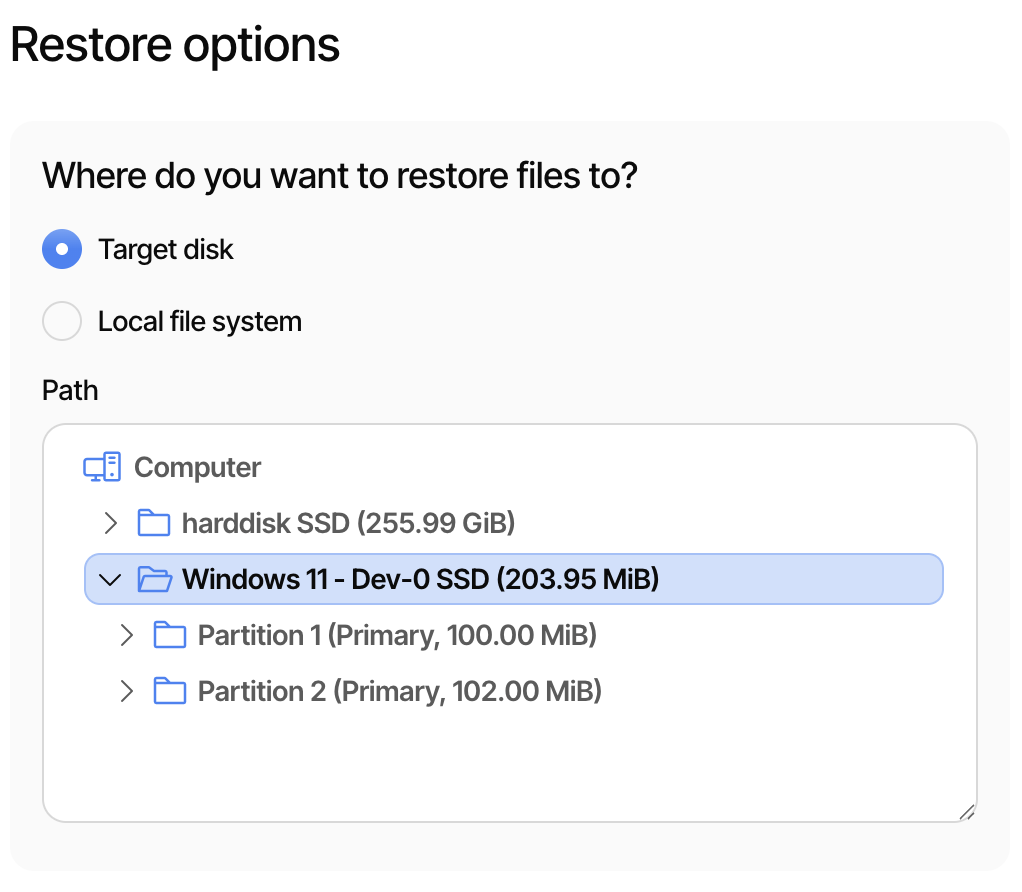
On the "Restore options" page, choose where the restored data should go:
Choosing the restore target
* **Target disk**: Writes the backup back to a physical disk or partition. Pick the target from the tree:
* Restoring a disk to a disk recreates the partition table and restores the partitions, producing a bootable disk.
* Restoring a partition to a partition writes only that partition, which is useful when the disk contains multiple partitions and only one should be restored.
* Restoring a partition to a disk creates a new partition on the target disk as needed.
* **Local file system**: Extracts the sectors from the disk backup to a regular folder. This is useful for forensics or for disk imaging tools.
{% hint style="warning" %}
Restoring to a target disk or partition **overwrites its contents**. Double-check that you have selected the correct target, and make sure the target is at least as large as the source. You cannot restore over the disk that the running operating system is on, so a full system restore is usually performed by booting from recovery media or by attaching the target disk to another machine.
{% endhint %}
When satisfied with the settings, click "Submit" and the restore process will write the data to the selected target.
---
# Agent Instructions
This documentation is published with GitBook. GitBook is the documentation platform designed so that both humans and AI agents can read, navigate, and reason over technical content effectively. Learn more at gitbook.com.
## Querying This Documentation
If you need additional information that is not directly available in this page, you can query the documentation by asking a question.
Perform an HTTP GET request on the following URL with the `ask` and `goal` query parameters:
```
GET https://docs.duplicati.com/automation-and-integration/full-disk-backup-and-restore.md?ask=&goal=
```
`ask` is the immediate question: it should be specific, self-contained, and written in natural language.
`goal` is what the user is ultimately trying to achieve, the reason they need the answer. Sharing it helps GitBook give you a better, more relevant answer. A goal is most helpful when it describes the outcome the user wants rather than restating the question. For example, with `ask=how do I create an API token`, a goal like `automate deployments from our CI pipeline` lets GitBook tailor the answer to that use case.
The response will contain a direct answer to the question and relevant excerpts and sources from the documentation.
Use this mechanism when the answer is not explicitly present in the current page, you need clarification or additional context, or you want to retrieve related documentation sections.